Facial Eczema
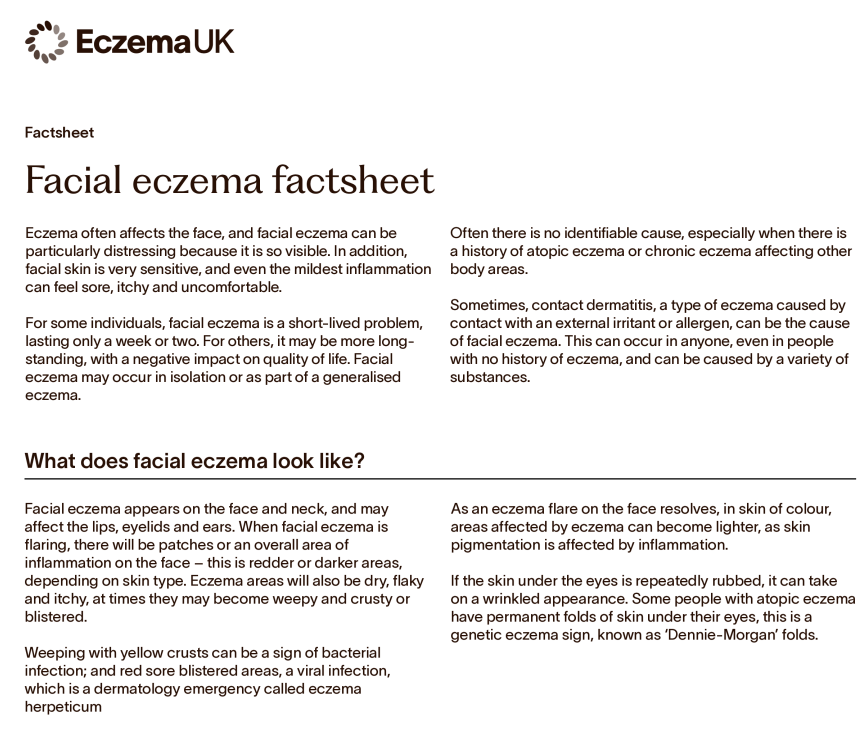
Eczema often affects the face, and facial eczema can be particularly distressing because it is so visible. In addition, facial skin is very sensitive, and even the mildest degree of inflammation can feel sore, itchy and uncomfortable.
For some individuals, facial eczema is a short-lived problem, lasting only a week or two. For others, it may be more long-standing, with a negative impact on quality of life.
Symptoms
The skin often becomes very dry and flaky. During more severe flare-ups, the skin may weep, develop crusts or form blisters.
Facial Eczema can affect people differently depending on skin tone and severity.
On white skin, eczema typically appears red and irritated.
On skin of colour, eczema may appear darker as skin pigmentation is affected by inflammation, and then, as eczema resolves, the skin can become lighter
Around the eyes
If the skin around and under the eyes is repeatedly rubbed, it can take on a temporary wrinkled appearance
Some people with atopic facial eczema may have permanent folds under the eyes. These are genetic and are known as ‘Dennie-Morgan folds’.
Types of eczema that affect the eyes
If you aren’t sure what type of eczema you have, here are all of the types of eczema that commonly affect the face.
Seborrhoeic dermatitis
Probably the most common form of facial eczema in adults, this condition is often mild, appearing simply as dry, scaly skin around the creases of the ears and eyebrows. However, some people suffer from considerable irritation and soreness, especially when the eyelids or ear canals are involved. Dandruff is an example of mild seborrhoeic dermatitis of the scalp. Like seborrhoeic dermatitis elsewhere, it tends to be a long-term complaint, which can improve with treatment, but cannot be permanently cured. Babies often develop seborrhoeic dermatitis on the scalp (this is known as ‘cradle cap’). This can occur in any infant and usually resolves by 6-12 months of age. It is different from adult seborrhoeic dermatitis, as it has a different cause.
Irritant dermatitis
Overuse and even limited use of facial products or makeup can lead to dryness and soreness of the skin - especially in someone with an eczema tendency. Even products labelled ‘dermatologically-tested’, ‘natural’ or ‘organic’ can cause irritation. None of these terms guarantees that a product will be trouble-free. Cosmetic products should be avoided when facial eczema is active, as they are only intended for use on normal/unaffected skin.
Allergic contact dermatitis
Allergic contact dermatitis occurs when the immune system in the skin overreacts to what has, until this point, been a harmless substance. The face is one of the most common sites for allergic contact dermatitis because facial skin comes into contact with many potential allergens in daily life.
Atopic eczema
In atopic eczema, the cheeks are one of the first parts of the body to be affected, and this usually occurs within the first few months of life. When a baby starts weaning, eczema is common around the mouth. After a year, eczema typically spreads to other areas, such as the arm and leg folds. Affected skin is red or darker, dry, flaky, itchy, and may sometimes weep or crust – this can be a sign of a bacterial infection. In babies under one year, facial eczema is very common around the neck folds and cheeks, but eyelid involvement is rare. In older children, the whole face and eyelids can be affected, especially if the child also has hay fever. All children who have had eczema will be left with sensitive skin, and eczema can return at any age. Adults with atopic eczema often have facial involvement, which can be a persistent area of eczema, and is often related to contact
Treatments
Eczema on the face requires careful treatment as facial skin is more easily irritated by and vulnerable to the side effects of topical therapy. It’s important to consider the possibility of an allergic contact dermatitis in anyone with a persistent facial eczema, even if they have a long-standing, in-built eczema tendency.
It’s helpful to make a diagnosis of which particular type of facial eczema someone has in order to know which treatment is likely to work best, and to help give an idea of the expected outcome. Usually, as eczema is a chronic condition, controlling facial eczema and preventing flares will be the main focus of treatment.
Emollients - Wash with a leave-on emollient and apply this frequently as a moisturiser. You can also use your emollient on a damp cotton pad to remove eye make-up, including mascara. Avoid washing your face with soap or using perfumed face creams.
Topical steroids - Topical steroids can be used for flares and topical calcineurin inhibitors for longer-term treatment and maintenance
Light sensitive eczema - Many people with eczema find that their skin improves in warm, sunny weather, and phototherapy (a prescribed course of ultraviolet therapy, administered and supervised in a hospital dermatology department) is an additional treatment option for chronic, widespread eczema. However, some people with atopic eczema or facial seborrhoeic dermatitis notice that their skin worsens in strong sunlight.
Triggers
Makeup and skincare products - If you think facial skin care products or make-up are having a negative effect on your skin, it is a good idea to go ‘bare-faced’ for a few days and see if that helps. If there’s an improvement, start to re-introduce products one by one to establish whether any of them are causing the problem. Cosmetic anti-ageing products that come into contact with eyelid skin can also cause irritation.
Detergents - Detergents or solvents coming into contact with the eyelids and can damage and irritate the skin
Overheating - Environmental factors such as sun, temperature and humidity may trigger flares, and the condition tends to worsen when an individual is run down or under prolonged psychological stress. Some people find that their skin improves in the summer, while others find that hot weather makes them itch and scratch more.
Harsh weather - Many find that their skin tends to be worse in the winter, when the face, in particular, is exposed to harsh winds, rain, sleet and snow. Moving from the cold into the dry heat of centrally heated buildings can also make the condition worse.
Licking lips - Children, in particular, occasionally suffer from a localised type of irritant contact dermatitis around the lips, as a result of repeated licking, known as ‘lip-licking dermatitis’. The habit arises because the person finds that their dry lips are temporarily more comfortable after being licked, but in the long-term, the repeated contact between saliva and skin does more harm than good.
Teething - Teething, too, commonly causes irritant contact dermatitis around the mouth and chin due to the constant wetness and irritation from dribbling
Runny noses and messy foods - Runny noses and messy foods when weaning can also cause problems.
Baby wipes - wipes containing irritants such as alcohol and fragrance can dry out and irritate the skin. It is best to use damp cotton pads with emollient on them as an alternative to baby wipes.