
Stress and eczema
.png)
Managing stress is so important for managing your eczema, but when life’s busy, it can be hard to know where to start.
Stress is our natural response to feeling threatened or under pressure. When we encounter a difficult situation, our fight or flight response is triggered, priming our body for action. This response can be useful – enabling us to push through the pain of running a marathon or the fear of giving a speech – but prolonged exposure to stress can leave us feeling overwhelmed or drained.
How does stress affect our skin?
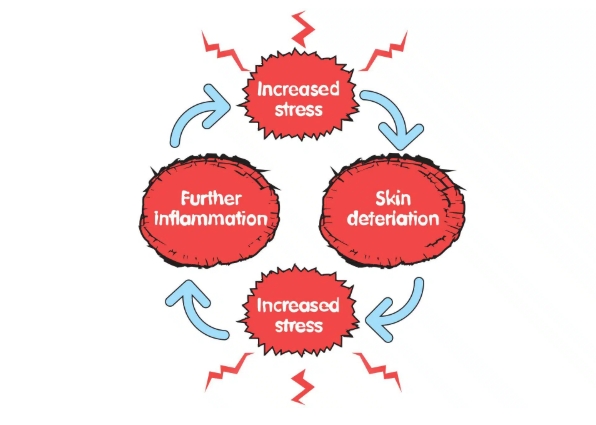
In the NES landmark 2020 patient survey Eczema Unmasked, people said stress was the single biggest trigger of their eczema flare-ups, with significantly more women (57%) affected than men (41%). As well as contributing to inflammation throughout the body, stress hampers the skin’s ability to repair. Crucially, it also sets off the vicious circle shown below:
How can I manage stress?
Everyone experiences stress – and each of us responds differently. The key to coping well is to focus on good stress management. This means prioritising the right tasks, delegating to others and being able to switch off from constantly worrying about what’s coming next. Importantly, it also means making time to relax, have fun and practise self-care. This is especially important when you are going through major life events, such as moving house, getting married, starting a new job or studying for exams. The stress can build up unnoticed over weeks and months. People often say that big events like these trigger more severe eczema flares-ups, which are then harder than usual to manage because they come on top of the existing stress.
For many of us, the hardest aspect is learning to prioritise our own needs ahead of the needs of others. But taking time for yourself isn’t an indulgence – it’s essential, to avoid burnout.
Tips for managing stress
Staying on top of stress levels doesn’t need to mean completely changing your life overnight. (In fact, trying to do that will only add to your stress levels!) Even small changes to your mindset and lifestyle can have a significant impact on the amount of stress you’re under and your ability to cope with it.
LEARN TO SAY NO. Lots of us are guilty of being people pleasers and saying ‘yes’ to everything. Before you do, pause and think. Do you really want to do this? Can you justify the time? If not, say ‘No.’ Another option is to say ‘I’ll think about it’ – but if you will feel stressed about having to refuse later, it may be easier to say ‘no’ straight away.
IDENTIFY YOUR TRIGGERS. Make a list of everything in your life that you find stressful and look for workarounds. If you dread the school run, could your partner take it on? If you’ve fallen out of love with your job, do you need to make time to polish your CV?
STAY FOCUSED. ‘To do’ lists are great but if they include too many actions, they can leave you feeling overwhelmed. It removes the sense of achievement if every time you cross a job off there are still so many left. Focus on your top ten tasks to maintain momentum.
LOSE THE BOOZE. It’s tempting to use a nightly glass or two of wine to unwind after a stressful day, but it can easily become a crutch. Alcohol also has a negative impact on the quantity and quality of sleep, which can also trigger a flare-up. Find another activity that helps you relax quickly – but is good for you in the longer term, too.
GET OUTSIDE. There’s a reason so many people turned to walking when the pandemic first started. Getting out into nature makes us feel healthier, better able to cope and improves our mood. Make time every day to head outdoors to get some fresh air and clear your mind.
YOU ARE WHAT YOU EAT. When you’re feeling stressed, it’s easy to skip meals or comfort eat. But what we eat directly affects our mental well being – and it’s vital to eat healthy, nutritious meals to protect your skin and to help it to repair itself.
ZZZZZZZ… Stress and poor sleep go hand in hand. Read our guide to getting a good night’s sleep.
GET MOVING. Regular exercise not only lowers the body’s stress hormones, such as adrenaline and cortisol – it also stimulates the production of endorphins (our ‘happy hormones’).
FIGHT BACK. Whenever your fight or flight response is triggered, counter it with relaxation. Take time out to practise whichever technique works best for you – yoga, mindfulness, meditation, breathing exercises or self-massage.
A PROBLEM SHARED. Get into the habit of talking about how you’re feeling with those around you, so that you have a support network. Other people can offer a different perspective, useful advice or simply a friendly, listening ear. If you feel you need additional support, reach out to your GP or a professional counsellor.
Top tips for building resilience
Resilience is our ability to navigate adversity and still function successfully – both physically and psychologically. It’s the core strength we use to manage what life throws at us.
To be clear, resilience is not about being stoic and simply putting on a brave face. Nor does it eradicate negative feelings or eliminate stress. What it can do, though, is put you in a better position to cope with the challenges you’re facing, so you don’t feel so overwhelmed, helpless and at the mercy of eczema. It’s about living successfully alongside eczema – not having your whole life defined by it.
We aren’t born resilient - it’s a skill that we develop. Our resilience levels aren’t static, either. We can grow them over time, as the process is ongoing.
So, how can you hone your resilience skills? Here are some suggestions that might help.
PRACTICE ACCEPTANCE. Focusing your time and energy on the unfairness of having eczema won’t improve your quality of life. It’s not easy, but try reframing your outlook to focus on what you can do that you love, rather than things you can’t do, or only with difficulty. This will help you to focus on the world beyond your condition and your own particular talents and strengths.
REACH OUT. Resilience isn’t about struggling on your own. It’s being able to reach out to family, friends or other people living with eczema and drawing on their experience, insight and support. Things always seem bleaker when it feels like it’s just you against the world. Gather people around you to help when things get tough.
FOCUS ON WHAT YOU CAN CONTROL. Eczema is, by its very nature, unpredictable – calm one day, raging the next. That’s true no matter how well you adhere to your treatment regime, avoid your triggers and try not to scratch. So, it’s easy to slip into thinking ‘What’s the point?’ But it’s important to remember that your actions do have a positive impact on your skin, even though it might not always seem that way, and that keeping going will help ensure more good days in the future.
STOCK UP. Give your body the resources it needs to help manage stress: proper nutrition, lots of hydration, regular exercise, rest and relaxation, and sufficient sleep. Whether you have eczema yourself or care for someone who does, this can be challenging – especially during flare-ups. But resilience is not about being perfect. Do the best you can in a difficult situation to build up your reserves and you’ll feel the benefits.
CHALLENGE YOUR GO-TO THINKING. If your normal response to adversity is to focus on everything that’s ever gone wrong in your life rather than the current challenge, it’s time to break the cycle. Being resilient means being able to focus on the here and now and taking a calm, measured approach to steadying the ship. Equally, if your normal response is to shut yourself away, make a conscious effort to reach out.
FOSTER POSITIVITY. Even at the worst of times, each of us has something, or someone, in their life that they can be grateful for. Journalling, meditation and mindfulness can all help shine a light on the positive aspects of life to counterbalance the negative emotions we may sometimes feel towards our condition. These techniques help us see our lives through a different, non-eczema, lens and believe in a better tomorrow.
SET GOALS. It might feel as though all your time, focus and effort goes into managing your eczema – but there’s more to you than your skin. Identify one or two non-eczema related goals and then do something every day, week or month that moves you closer to them. It’s about making eczema part of the picture – not the whole picture.
BE FLEXIBLE. You can have the most detailed and comprehensive plan in the world, but it won’t stop eczema throwing a curve ball from time to time. Ploughing on regardless, and pretending nothing’s happened, is likely to only make things harder. Embrace playing things by ear – who knows, the new plan might work out even better than the original one.
DON’T BE HARD ON YOURSELF. Eczema is not a computer game that you have to complete with the highest score! All you can ever do is your best. Some days, that’s going to feel like climbing a mountain, even though you aren’t a mountaineer. Resilience means having a bad day, then picking yourself up the next day and starting again. It’s about not focusing on taking a step backwards but concentrating on how many steps forward you’ve already taken this year.
You’re already light years ahead!
Remember, as someone used to living with a long-term condition, you’re probably already more resilient than you give yourself credit for. Using the techniques on this page will only enhance your strengths and leave you better able to cope with the challenges ahead.