
Children & eczema
.png)
Eczema affects 1 in 5 children in the UK. Uncontrolled eczema has a huge impact on a child’s quality of life. Itchiness leads to sleepless nights, difficulty concentrating and missing school. Children with severe eczema can also feel embarrassed about the appearance of their skin and have low self-esteem, sometimes even clinical depression. However, when eczema is well-managed it's possible to limit its impact on day-to-day life.
Common eczema symptoms
Atopic eczema is a dry skin condition that may be red, sore and dry. Its chief characteristic is the ‘itch’, which at times can become almost unbearable, causing a child to want to scratch constantly, especially at night, thereby interfering with sleep. If a child has moderate to severe atopic eczema, they may have red patches of skin (inflammation) and scratch until their skin bleeds. However, since the skin is very dry, it can also crack and bleed of its own accord. Any cracked, raw or bleeding areas are especially vulnerable to infection.
Atopic eczema usually appears during the first few months of life, often starting on the face and scalp. It can be present on any area of the body, but in white children it usually affects the skin creases, neck, back of knees and inside of elbows. There may also be roundish, 50p-shaped areas of eczema, known as ‘discoid eczema’.
Children from Asian, African or Afro-Caribbean families often have different patterns to white children with eczema. These include eczema around the front of the knees and the back of the elbows (called the ‘reverse flexural pattern’) as well as in the creases, as seen on white skin. A papular pattern, which appears as fine bumps over the chest and tummy, is also common.
Infected eczema symptoms
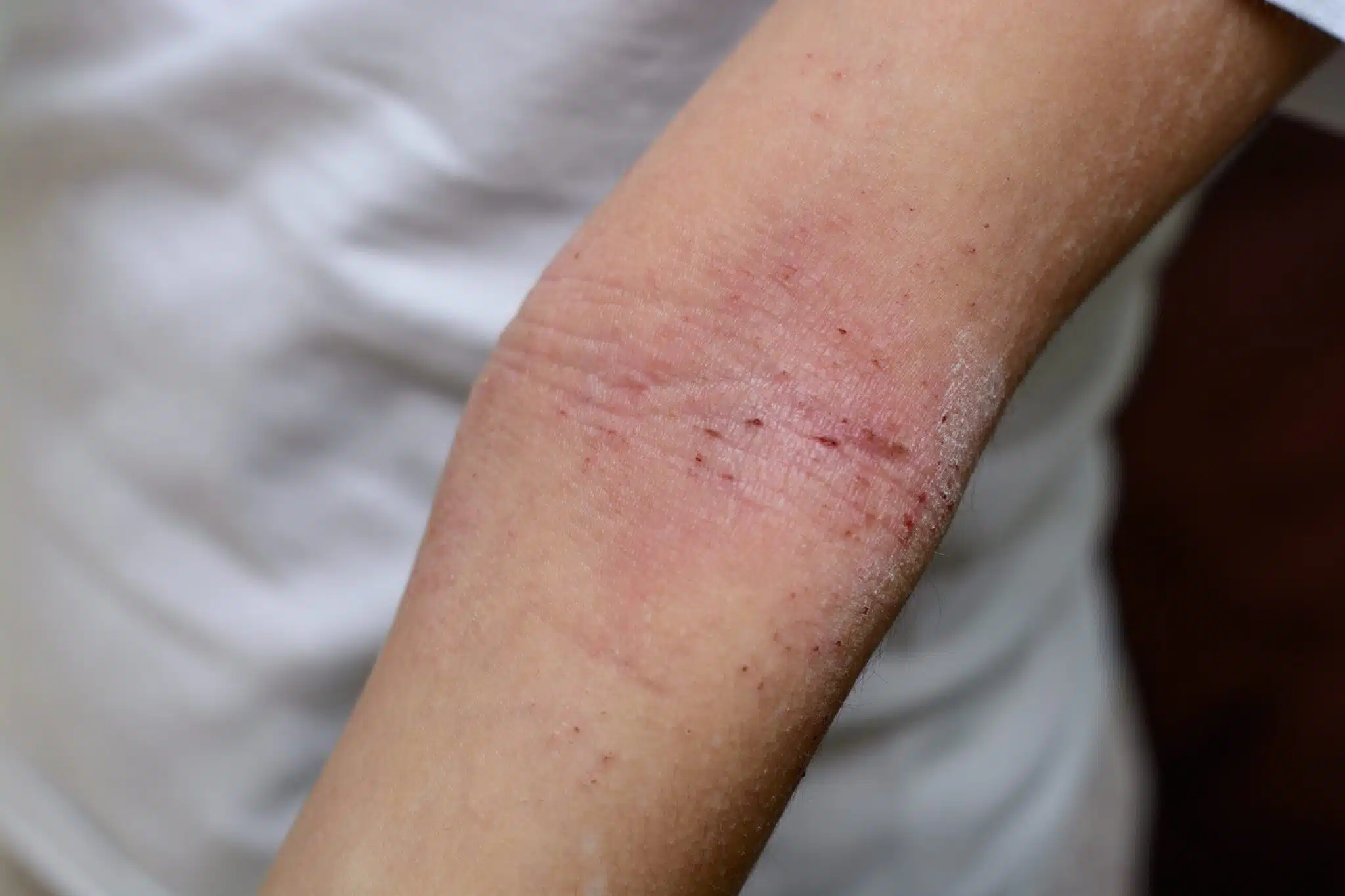
If a child has infected eczema, it may be very red and weepy and there may be small blisters. If the eczema has been persistent, the skin may feel and look thickened in areas where there has been lots of rubbing and scratching. There may be cracks and splits, which can be very painful, especially on the hands, making it difficult to hold a pen or pencil.
Atopic eczema can vary in severity between different children. Some children have dry skin and eczema that can be kept under control with simple treatments, while others may need a variety of more complex treatments. You will get to know what your child’s eczema looks like, what treatments will be needed for flares (when the skin becomes hot, inflamed, itchy and sore) and when your child needs to visit a healthcare professional. However, if the eczema gets worse or looks different, you should always ask for medical help.
Help young children self-manage their eczema
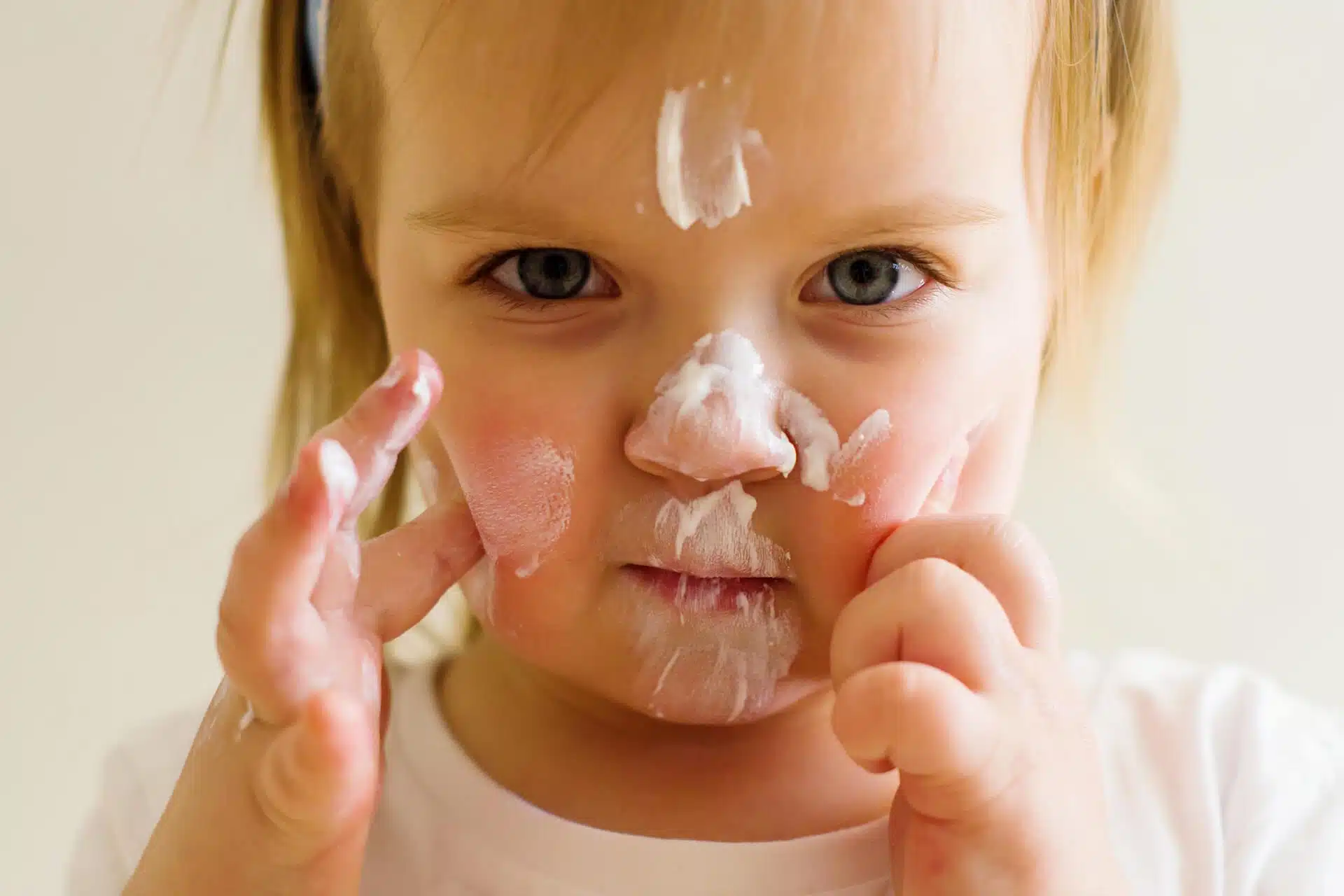
Regular emollient application is essential for everyone with eczema. In the following article, Alice Lambert explores ways to make applying emollients fun for young children to help instil a habit of good eczema self-care.
Encouraging application
Start small - When they are ready to start applying emollient to themselves, encourage them to apply it to a particular part of the body to start off with, such as one arm. Then add more areas as they become more proficient.
Family affair - Apply emollient to yourself while your child applies their own emollient. If an older sibling joins in too, so much the better. If your younger child is the only one with eczema, this does mean using emollient unnecessarily (and expensively). But it’s an effective way of normalising emollient application and showing how it’s done.
Involve a toy - Before your child becomes ready to apply emollient to their own body, encourage them to apply it to a favourite plastic doll or other easily rinsed toy. This can help get them interested in the process.
Explain why - Children are more likely to go along with an eczema care routine if they understand why it’s needed. Explain in simple terms what eczema is and why it’s important to apply emollients and topical steroids.
Children’s books and resources that help with this include The Itchy-saurus by Rosie Wellesley, The Same But Different by Remy Antoinette and Yury Borgen, and The Dragon in My Skin online book, video and song, created as part of the Eczema Mindlines project.
How to apply emollients
Wash your hands before applying emollient.
Apply emollient all over the body rather than only on eczema patches.
Apply emollient in smooth, downward strokes. Don’t rub it in.
If reaching the back is a struggle, apply emollient to the back of the hand and forearm, and use them to smooth emollient onto the back instead. Or try a back applicator (search online for ‘lotion back applicator’). Children can grip an applicator halfway down the handle rather than at the end, if it’s too long.
How to keep up the momentum
Power of packaging - Encourage your child to decorate their tubs, dispensers and spray bottles with stickers and, if the packaging allows, stick-on gems and bows. Give emollients enticing new names, like ‘Princess Amelia’s Arctic Snow Spray’, ‘Jellyfish Jelly’ or ‘Magic Unicorn Wonder Cream’.
Praise and rewards - Give your child lots of praise when they apply their emollient. Add a sticker to a star chart every day they apply emollient themselves, and if they’ve stuck to their routine, give them a reward at the end of the week. If they make the chart themselves, and are able to choose the sticker, this should help them feel more invested. Rewards could include an extra bedtime story, making play dough or a picnic in the park.
Try something new - If your child is reluctant to apply emollient, ask whether they’d like to try a different one. Emollient preference is individual and can change over time.
There are different types and textures: ointments, creams, gels, lotions and a spray. See our Emollients page for more information on what’s available.
How to make application fun
Emollient application becoming a chore? Here are some imaginary scenarios you could try out:
Spa day: Pretend your child is visiting a luxurious spa, trying out a new treatment. Play the aesthetician and tell them all about the properties of this incredible new treatment (the emollient) while they apply it. The properties of the treatment can change every time the child visits the spa. In this spa, the client must apply the treatment themselves and in the correct way – otherwise it won’t work properly.
Channel swimmer: It might be a myth that Channel swimmers used to apply goose fat to keep warm in the water – but what’s a little historical inaccuracy in the service of eczema care? Pretend your child is about to swim the Channel and needs to grease themselves up in preparation for this. While they apply emollient, play the part of a reporter and interview them about the challenge ahead. If being a swimmer doesn’t appeal, how about a wrestler or bodybuilder?
Magic potion: Pretend your child’s emollient is a magic potion that will give them a superpower of their choice. While they apply it, ask them to describe how they will use their power. They can choose a different superpower each time and it can be as weird or obscure as they like: for example, the power to unpeel a banana with their toes or give wallpaper a new pattern simply by staring at it.
Drawing: Alternatively, play games with the emollient itself. Your child could dot it on their skin and then join the dots. Or give themselves ladybird or leopard spots or tiger stripes. Then ask them to act out the creature they’re pretending to be so you can guess what it is, before they smooth the emollient in.
Storytelling: If you’re a confident storyteller, you could tell your child a special story that you only tell while they apply emollient. Feature them as the protagonist and make sure to end each session on a cliffhanger, so they’re eager for the next instalment!
Music: If singing is something you both enjoy, you could make up a song about applying emollient to sing whenever it’s applied, or play music while your child applies emollient.
Reading: Either read aloud, or put on an audiobook or podcast while your child applies their emollient. The National Literacy Trust has some children’s podcast suggestions on their website (some are aimed at older children).
TV and video: YouTube videos or television are likely to be too distracting while your child applies emollient. But you could put them on while your child waits for their emollient to absorb.
Messing around: One of our Instagram followers suggested doing a special, funny walk while waiting for emollient to absorb – a different style every day!
Help young children open up about eczema
In the following article, Claire Moulds offers advice on helping pre-school children talk about their eczema and how it makes them feel.
A huge part of the challenge of caring for young children with eczema is that they don’t fully understand what’s going on, why they might seem different to their friends, and how to communicate and manage all the different feelings they’re experiencing.
At times, this might result in tantrums, pushing boundaries, yelling and lashing out because it’s the only way they can express themselves.
While it’s important not to bottle things up, it’s also important that children feel able to open up to an adult before they reach this stage.
So, how can you establish an open, positive, ongoing dialogue about eczema with your young child?
Explain eczema in a way that makes sense to them
While all children will be able to understand that their skin is poorly, different ages and different abilities will need a tailored approach when talking about eczema.
It’s important, though, that eczema is explained. Not understanding what’s wrong with them only exacerbates the confusion, frustration and distress that children can feel.
For very young children, a ‘tell, show, do, review’ approach can be very effective:
Tell ‘Because your skin doesn’t work properly, we have to give it a helping hand’
Show ‘So we apply these special creams to help it to feel better’ (apply emollient at the same time)
Do Encourage your child to copy what you’re doing and to tell you why they’re doing it to confirm they’ve understood what you’re trying to tell/show them
Review Be plentiful with praise to encourage them on their eczema discovery journey.
Other children might benefit from using a favourite book or cartoon to explain the complicated concept of having a dysfunctional skin barrier.
For example, in ‘the three little pigs’, a brick house keeps the little pigs safe and sound because it’s strong compared to the ones made of straw or sticks. You can explain that skin is our body’s wall and that their wall isn’t as strong as it needs to be, which is why we apply emollients.
Other children might appreciate the example of a ‘force field’ that protects the spaceship and its crew from harm: emollient offers the same protection for our skin.
As children get older, you can revisit the explanation and these metaphors, tailoring them to reflect their ability.
Help children identify their feelings
The experience of having eczema can produce a lot of feelings for a small child to handle – let alone to find the right words to convey. Initially, they may need help to identify different emotions.
Keep giving children the opportunity to explain how they’re feeling throughout the day, so it doesn’t become too much for them. Ask them how they are. If they seem angry or upset or sad, say, ‘It looks like you’re feeling sad. Do you want to talk to me about what’s made you feel that way?’
Share your own emotions (good and bad) throughout the day too. This helps children understand that sharing feelings is a good thing, as it means we aren’t alone and we can help each other.
If the feelings do become overwhelming, help your child to calm down before you talk things through. That might mean taking deep breaths, counting to 10, doing star jumps or having a cuddle.
Reassure them it’s okay to have these feelings and that they’re normal. After all, anyone would be irritable if their skin was sore and itchy, because it’s an uncomfortable feeling: you can’t relax in your own body.
Tell them again that you’re always there for them, whenever they want to talk, about anything at all. Having eczema feels like being on an emotional rollercoaster and knowing you’ll always be there will help them to navigate all the ups and downs.
When words aren’t enough
It might help to create your own eczema language for when the words aren’t there.
Small children might find taking on a character a helpful way to get across how they’re feeling – for example:
They might become an octopus when the itch is so bad and so widespread that they don’t have enough arms to deal with it.
They might become a dragon when their skin is burning and hot.
They might become a porcupine when they feel spiky and annoyed and don’t want to be touched or to talk.
If they are struggling to talk about their emotions, encourage them to draw or paint them. Physical activity is another way to let out emotions and reduce stress. Ask if you can do activities together so you’re there if they feel like opening up.
How to answer their questions
It can be daunting inviting your child to ask you anything they want about their eczema. But it’s not about having all the answers. It’s about understanding what’s worrying them and how you can help.

Here are the common questions your child may ask you and our advice on how to answer them.
For more information on managing eczema in children, please see our Childhood Atopic Eczema booklet and School Information Pack.
.png)
.png)